+86-13901441113


Choosing a China top Outdoor Playground Slide manufacturer requires more than comparing glossy catalogs and low prices. It requires evidence, site knowledge, and careful questions. A reliable supplier should explain its design process, steel or stainless-steel options, plastic quality, welding controls, and surface finishing. Product photographs are not enough.
“Play is the business of childhood,” says Dr. Joe L. Frost, a respected playground researcher and author. His words remind buyers that a slide is not merely colorful equipment. It shapes movement, confidence, social interaction, and everyday risk awareness. The best manufacturers understand this responsibility. They design suitable heights, smooth transitions, secure platforms, protective railings, and accessible circulation areas.
Look closely.
A serious Chinese manufacturer should provide material specifications, load testing records, installation guidance, inspection procedures, and dependable after-sales support. Independent certifications can strengthen confidence, but buyers should verify their scope and validity. A certificate alone does not prove every model is safe for every site. Local climate, drainage, fall zones, age groups, and supervision patterns still matter.
Some factories offer impressive customization. Others mainly resell standard products. That difference affects communication, replacement parts, delivery control, and long-term maintenance. No supplier is perfect, and a polished website may hide weak documentation. A useful evaluation should admit uncertainty, request samples, inspect production details, and compare promises with physical evidence. For buyers seeking an Outdoor Playground Slide partner in China, the strongest choice combines manufacturing experience, transparent engineering, tested materials, and a willingness to discuss limitations honestly.
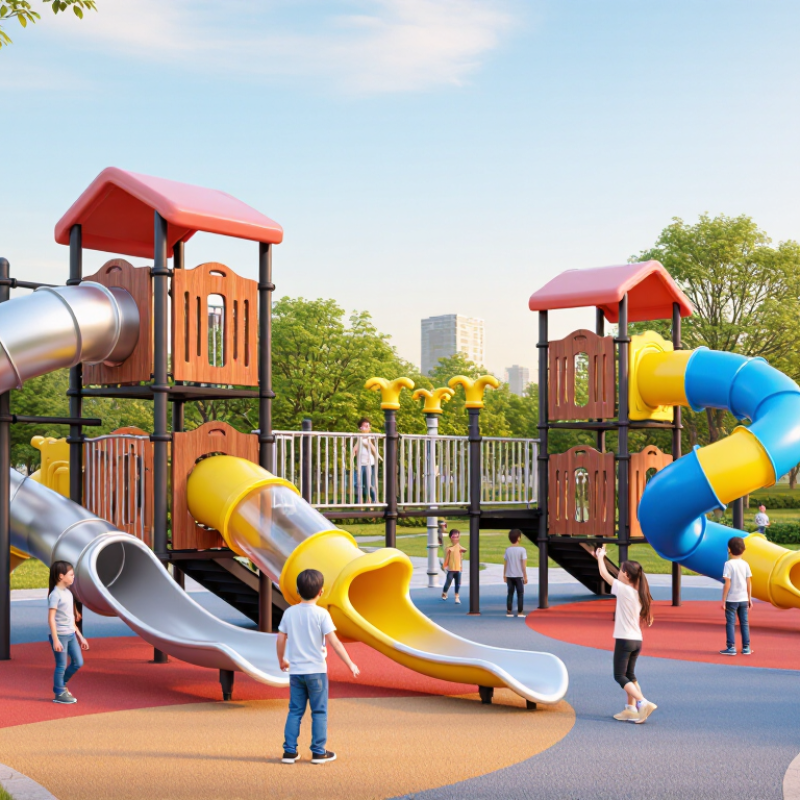
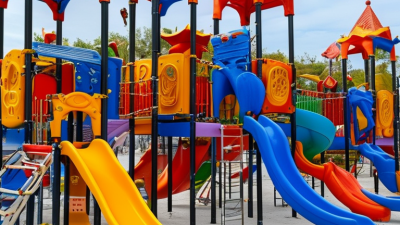
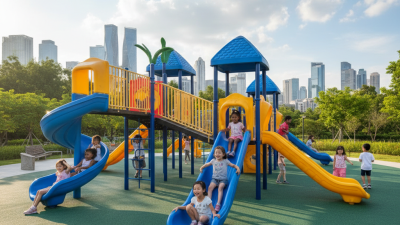
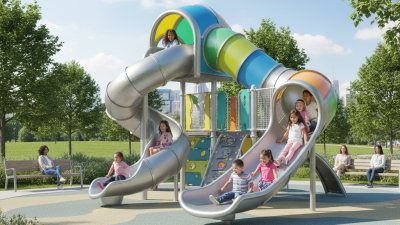
China’s outdoor playground slide market serves schools, resorts, parks, and residential communities. Manufacturers commonly produce straight, wave, spiral, tube, and combination slides. Product choices vary by age group, site size, budget, and climate.
Stainless steel slides offer a fast, smooth ride and strong resistance to heavy use. HDPE and fiberglass models provide colorful shapes and flexible design options. Rotationally molded plastic suits compact playgrounds, while tube slides create enclosed routes and extra visual appeal. Experienced buyers should check slide height, exit speed, handrails, ladder spacing, and fall-zone requirements. Material thickness matters more than glossy surface finishes.
Reliable manufacturers should provide drawings, load information, installation instructions, and material traceability. Ask for UV-resistance data, drainage details, weld inspection records, and surface testing. Compliance may involve standards such as EN 1176 or ASTM F1487, depending on the destination market. Factory audits can reveal packaging quality, assembly control, and production consistency. Do not trust photographs alone. A beautiful sample may hide sharp edges, weak connectors, or poor drainage. Some projects also underestimate shipping volume and installation time. That mistake can affect the final budget. Regular maintenance remains necessary, even with durable materials. Safety depends on design, installation, supervision, and inspection working together.
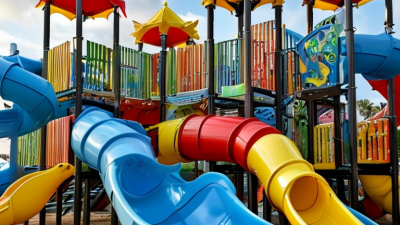
China’s outdoor playground slide market commonly includes straight, wave, spiral, tube, and multi-lane slide systems. The chart compares representative commercial platform-height benchmarks by product type; actual specifications vary according to age group, safety standards, site layout, and project requirements.
China Top Outdoor Playground Slide Manufacturer?
Safety begins with measurable design, not attractive colors. ASTM F1487-21 and EN 1176-1:2017+A1:2023 provide different technical frameworks for playground equipment. A responsible manufacturer studies both carefully. Neither standard should be treated as a marketing label.
Fall height needs special attention. It is not simply the slide platform height. Designers assess the highest accessible point where a child could fall. They then specify impact-attenuating surfacing for that height. Sand, engineered wood fiber, rubber tiles, and loose-fill materials behave differently after rain, compaction, or poor maintenance. The surface must match the tested performance, not just the product description.
A practical inspection checks guardrails, openings, edges, fasteners, and landing areas. We also review drainage and surface depth around the exit. Small changes matter. A worn landing zone can increase injury risk. ASTM and EN requirements may differ, so one certificate cannot automatically prove compliance with the other. Independent testing and documented installation records provide stronger evidence. Still, paperwork is not enough. We have seen good designs weakened by incorrect anchoring or insufficient surfacing. That lesson deserves more attention. Local authorities may also require additional rules beyond these standards. Safety should be reviewed before shipment, during installation, and throughout the playground’s service life.
Material performance separates a reliable outdoor slide from a costly replacement. HDPE offers low moisture absorption, smooth surfaces, and strong chemical resistance. Its weakness is heat expansion and gradual color fading.
A responsible manufacturer should specify UV-stabilized resin and verify weathering through ISO 4892 exposure methods. Color alone is not enough. We inspect surface chalking, brittleness, and edge cracking after testing.
Stainless steel supports high traffic and repeated cleaning. Grade selection matters near coastlines, where salt can accelerate corrosion. Welds should be visually checked and tested for defects, while sharp transitions need careful polishing.
ASTM F1487 and EN 1176 provide recognized frameworks for playground structural safety and equipment evaluation. Load testing should represent real assembly conditions, including fasteners, platforms, guardrails, and repeated movement.
Static results can mislead when joints loosen later.
The U.S. Consumer Product Safety Commission reports more than 200,000 playground-related injuries treated in emergency departments each year, with falls representing roughly 79 percent of cases.
That figure makes impact protection and structural consistency practical priorities, not paperwork. We recommend independent laboratory records, batch traceability, UV test results, and installation torque records.
A perfect material does not exist. Even strong HDPE can fail when drainage, ventilation, or maintenance is ignored. Small details matter.
Choosing a reliable outdoor playground slide manufacturer requires more than attractive product photos. A serious factory should show a working ISO 9001 quality management system, not just display a certificate. Verify the certificate issuer, covered production scope, issue date, and current validity. The documents should match the actual factory address and product category. Ask for audit records when possible. Some factories present certificates without explaining their limits.
Quality control should be visible on the production floor. Inspect stainless steel thickness, plastic wall consistency, welding points, and edge finishing. Workers should record incoming material checks before cutting or molding begins. During assembly, inspectors can measure slide angles, platform heights, bolt tightness, and surface smoothness. Load testing and repeated-use testing provide stronger evidence than visual inspection alone. Small defects matter.
Traceability connects each finished slide to its production history. A useful record may include resin or metal batch numbers, operator names, inspection dates, and packing photos. Certification reports from recognized testing laboratories can support material and safety claims, but they still require careful review. A factory may pass one sample while another unit needs correction. That possibility deserves attention. During evaluation, I would request a sample inspection, compare it with production records, and check whether corrective actions are documented. No process is perfect. Reliable manufacturers admit gaps and show how they fix them.
When evaluating a top outdoor playground slide manufacturer, start with measurable supplier terms, not polished photographs. MOQ affects cash flow, spare units, and project flexibility. A capable supplier should state whether MOQ applies per model, color, or container. Ask for a written quotation. Small detail, big impact. Lead time deserves equal attention. Request separate timelines for drawing approval, production, inspection, and loading. A realistic schedule includes material shortages and seasonal congestion. “Fast” is not a specification.
Warranty terms should identify covered parts, service duration, exclusions, and response time. Check whether coverage includes coatings, welds, fasteners, and plastic panels. A two-year promise means little without replacement procedures. Ask for installation guidance and maintenance records. Good documentation shows working knowledge. It also exposes weak assumptions. I would not accept a warranty copied from a generic template. For customization, require drawings, safety clearances, colors, platform heights, and site dimensions before production. A supplier may customize appearance but not structural limits. That distinction matters. Approve a sample or signed technical drawing. Mistakes become expensive after fabrication.
Export capacity should be verified through packing lists, container plans, destination references, and inspection reports. Ask how the supplier protects slides from scratches during sea transport. Photos of edge protection and moisture control are useful. Request documents for materials, testing, and shipment tracking. A factory producing many units may still struggle with one complex order. Capacity is not only volume; it is consistency. Compare at least three written offers using the same specification. Record response speed and technical clarity. These are practical reliability signals. Do not choose on price alone. That approach can fail. A higher quotation may include stronger packaging, clearer warranty support, and fewer site delays.
| Evaluation Criteria | Supplier Profile A Large Export Manufacturer |
Supplier Profile B Mid-Size Custom Factory |
Supplier Profile C Project-Focused Producer |
Supplier Profile D Small-Batch Specialist |
|---|---|---|---|---|
| Typical MOQ | 1 complete set for project orders; 10–20 units for standard slides | 1 complete set; 5–10 units for repeat designs | 1 complete project or 1–3 large structures | 1–5 units, subject to design and material availability |
| Standard Product Lead Time | 25–40 days after approval and deposit | 30–45 days after approval and deposit | 35–55 days, depending on project complexity | 20–35 days for simple standard items |
| Custom Design Lead Time | 45–75 days, including engineering and sample approval | 40–70 days, including 2D or 3D design revisions | 60–90 days for themed or multi-zone installations | 35–60 days for limited customization |
| Warranty Coverage | 12–36 months; structural components may receive longer coverage | 12–24 months for main structure and manufacturing defects | 12–36 months, subject to installation and maintenance conditions | 12 months for standard products |
| Customization Capability | High: colors, dimensions, layouts, logos, themes, and accessory combinations | High: custom layouts, materials, colors, and site-specific adaptations | Very high: themed playgrounds, integrated towers, and complete site planning | Medium: colors and selected dimensions; limited structural changes |
| Common Materials | Rotomolded LLDPE, galvanized steel, stainless steel, HDPE panels, EPDM components | Rotomolded LLDPE, powder-coated steel, stainless steel, HDPE, and aluminum parts | LLDPE, galvanized or stainless steel, fiberglass-reinforced elements, HDPE, and timber alternatives | LLDPE, painted steel, HDPE panels, and standard stainless-steel hardware |
| Safety Documentation | Assembly drawings, installation manuals, load information, and test documentation on request | Assembly drawings, maintenance instructions, and material or component certificates | Project drawings, installation plans, safety documentation, and site-specific technical files | Basic assembly instructions and standard product documentation |
| Export Experience | Regular shipments to multiple regions; suitable for container-scale orders | Regular export activity; suitable for small and medium project orders | Project-based exports; stronger support for complete playground installations | Occasional export orders; best suited to sample or small-volume purchases |
| Container Loading Capability | Experienced with 20-foot and 40-foot container planning | Can consolidate mixed products for standard container shipments | Suitable for complete project containers with coordinated packing lists | Usually dependent on freight forwarder or consolidated shipment arrangements |
| Quality Control Practices | Incoming material checks, in-process inspection, final inspection, and packing verification | Production inspection and final checklist; inspection scope should be confirmed per order | Project-level inspection with emphasis on fit, assembly, and site requirements | Basic final inspection; third-party inspection may be arranged separately |
| Best Fit For | Distributors, schools, resorts, municipalities, and recurring import programs | Importers requiring customization with moderate order quantities | Large parks, commercial developments, and turnkey playground projects | Samples, replacement parts, small venues, and low-volume orders |
| Overall Procurement Consideration | Strong balance of capacity, export support, and product range | Good balance of flexibility and moderate customization cost | Best for complex designs and complete project coordination | Useful for low quantities, but verify capacity and documentation carefully |
Note: The figures above represent common market ranges for China-made outdoor playground slide suppliers. Actual MOQ, lead time, warranty terms, safety documentation, and export capability should be confirmed in the supplier’s quotation, technical drawings, contract, and pre-shipment inspection records.